American Friction Welding • Manufacturing Advantages

Advantages of Friction Welding

Reduce machining and material use, create near-net-shape blanks, evaluate dissimilar-metal designs and build around a repeatable solid-state joining process.

Why Manufacturers Evaluate Friction Welding

The biggest advantage may be changing how the part is made.

Friction welding is not only an alternative way to make a joint. In the right application, it can change the material strategy, starting-stock geometry, machining route and production economics of the component. Manufacturers often evaluate it when they are machining away too much material, waiting on a specialized forging, trying to combine different alloys, or looking for a repeatable solid-state joining process.

New to the technology? See how the friction welding process works.

Manufacturing Route

Where friction welding can change the economics of a component

Not every part follows this exact path, but the opportunity is easiest to see by comparing a conventional one-piece or fusion-welded route with a friction-welded near-net-shape strategy.

Conventional route

Start large, remove material, then join or finish.

  1. Buy an oversized billet, forging or other starting form.
  2. Machine significant material away to create the required geometry.
  3. Use the same material through areas that may not need its performance.
  4. Prepare and complete any conventional joining operations.
  5. Finish-machine, inspect and validate the completed component.
This route may be entirely appropriate, but it can tie up expensive material, machining capacity and tooling.
vs.
Friction-welded opportunity

Start closer to final shape and put material where it is needed.

  1. Produce simpler sections closer to their final geometry.
  2. Select material independently for different functional areas.
  3. Friction weld the sections into a near-net-shape blank.
  4. Reduce the amount of stock removed during final machining.
  5. Validate the weld and complete the final production sequence.
When geometry, materials and volume fit the process, this route can reduce waste and create additional design freedom.
Four Major Advantage Areas

What manufacturers are usually trying to gain

01

Design freedom

Use the material and geometry that make sense in each portion of the component instead of forcing one starting form to do everything.

  • Evaluate similar and dissimilar material combinations
  • Place premium alloy only where its properties are required
  • Create cast- or forge-like near-net blanks without dedicated forging tooling
02

Manufacturing efficiency

Reduce the work required before the part reaches its finished geometry.

  • Reduce raw material that ultimately becomes chips
  • Reduce machining labor and perishable tooling use
  • Evaluate alternatives to long-lead specialized starting forms
03

Production consistency

Develop the weld around measurable machine parameters rather than relying on a deposited filler-metal joint.

  • Control rotational speed, axial force, displacement and timing
  • Support prototypes through recurring production quantities
  • Use comparatively simple joint preparation on suitable parts
04

Solid-state joint characteristics

Create the bond without intentionally melting the parent materials at the interface.

  • Narrow heat-affected region
  • No filler metal, flux or shielding gas required at the joint
  • No molten weld pool, avoiding slag and gas-porosity mechanisms associated with fusion welding
Process Comparison

How the manufacturing considerations differ

These are general process characteristics, not a claim that friction welding is automatically better for every component. Final feasibility depends on materials, geometry, gripping, process parameters and production requirements.

Consideration Rotary friction welding Conventional fusion-weld route
Filler materialNot requiredMay be required depending on process
Flux / shielding gasNot required at the weld interfaceOften required depending on process
Parent-metal meltingNo intentional meltingJoint is formed through a molten weld pool
Dissimilar-material opportunityBroad range can be evaluatedSome combinations are difficult or impractical
Near-net-shape strategyStrong opportunity on suitable geometryNot inherent to the joining process
Joint preparationOften comparatively simpleCan require bevels, fit-up and surface preparation
Production controlDeveloped around machine parametersDepends on the selected fusion process and procedure
Cost + Machining Efficiency

Reduce the amount of material and machine time tied up in the part.

Instead of machining a complex component from one oversized billet, bar or forging, manufacturers can sometimes produce separate sections closer to final geometry and friction weld them together. That can reduce raw material consumption, machining labor, perishable tooling usage and spindle time on constrained equipment.

Near-net-shape design can also create alternatives to expensive custom forgings or large starting stock when the component geometry and production requirements are suitable.

Learn more about cost reduction & efficiency gains →

Less material becomes chips.Start closer to the geometry that will actually remain in the component.
Machining capacity stays available.Reduce hours spent roughing away material before value-added features are created.
Premium material is targeted.Use expensive or specialized alloys where they contribute functional value.
Starting-form options expand.Evaluate fabricated near-net blanks where forging or oversized stock is inefficient.
Materials + Design Flexibility

Dissimilar-metal capability can change the component, not just the weld.

One of the most important advantages of friction welding is the ability to evaluate combinations of dissimilar materials. Because the process heats the interface to a plasticized state rather than intentionally melting the base materials, it can make some combinations practical that are difficult or unsuitable for conventional fusion welding.

That can give engineers more freedom to place corrosion resistance, wear resistance, strength, thermal performance or other material properties only where they are required.

  • Premium alloy joined to a lower-cost structural material
  • Wear-resistant end joined to a machinable shaft body
  • Corrosion-resistant material used only in the exposed region
  • Different manufacturing processes combined in one component
  • Near-net-shape sections joined before final machining

Check the Dissimilar Metals Chart →

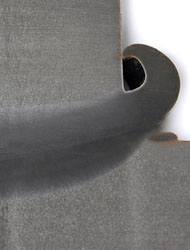
Cross-section showing weld integrity in a friction-welded component
Cross-section of a friction-welded joint
Welding with Integrity

A properly developed friction weld creates a full-interface structural joint.

Friction welding develops the joint across the designed weld interface rather than depositing a bead around the outside perimeter. When the process, materials, geometry and post-weld requirements are properly developed and validated, the resulting joint can support demanding structural applications.

The narrow heat-affected region and solid-state nature of the process also avoid several defect mechanisms associated with a molten weld pool. Final acceptance should still be based on the component's actual specifications and required inspection or testing plan.

Explore Weld Testing Solid-State Welding
Consumables + Environmental Considerations

Eliminate several consumables associated with conventional fusion welding.

Friction welding does not require filler metal, flux or shielding gas at the weld interface. Joint preparation can also be simpler for suitable parts, reducing some additional processing associated with preparing a fusion-weld joint.

The process itself does not create a conventional arc-welding plume from filler metal, flux and shielding-gas interaction. Actual environmental impact still depends on the complete manufacturing route, including machining, material sourcing, power use and any pre- or post-weld processing.

Explore environmental manufacturing considerations →
Related Questions

Continue with the part of the decision that matters to your program.

Evaluating a broader production, material or sourcing problem? Explore AFW Friction Welding Solutions →

Next Step

Could friction welding improve the way your component is designed or manufactured?

Send AFW the drawing, materials, quantities and manufacturing problem you are trying to solve. We can help determine whether the process offers a practical advantage for the application.

Start a Part Review Contract Friction Welding Services
Contact American Friction Welding today for more information or to request a quote!